The Best AI Apps for Shopify to Improve AI Visibility
The search box has officially become the answer box. Your competitors might rank highly on old search layouts, but they remain completely invisible when high-intent buyers ask ChatGPT or Gemini for a specific product recommendation. Surviving the shift to requires moving past standard dashboards and injecting directly into your store metadata.
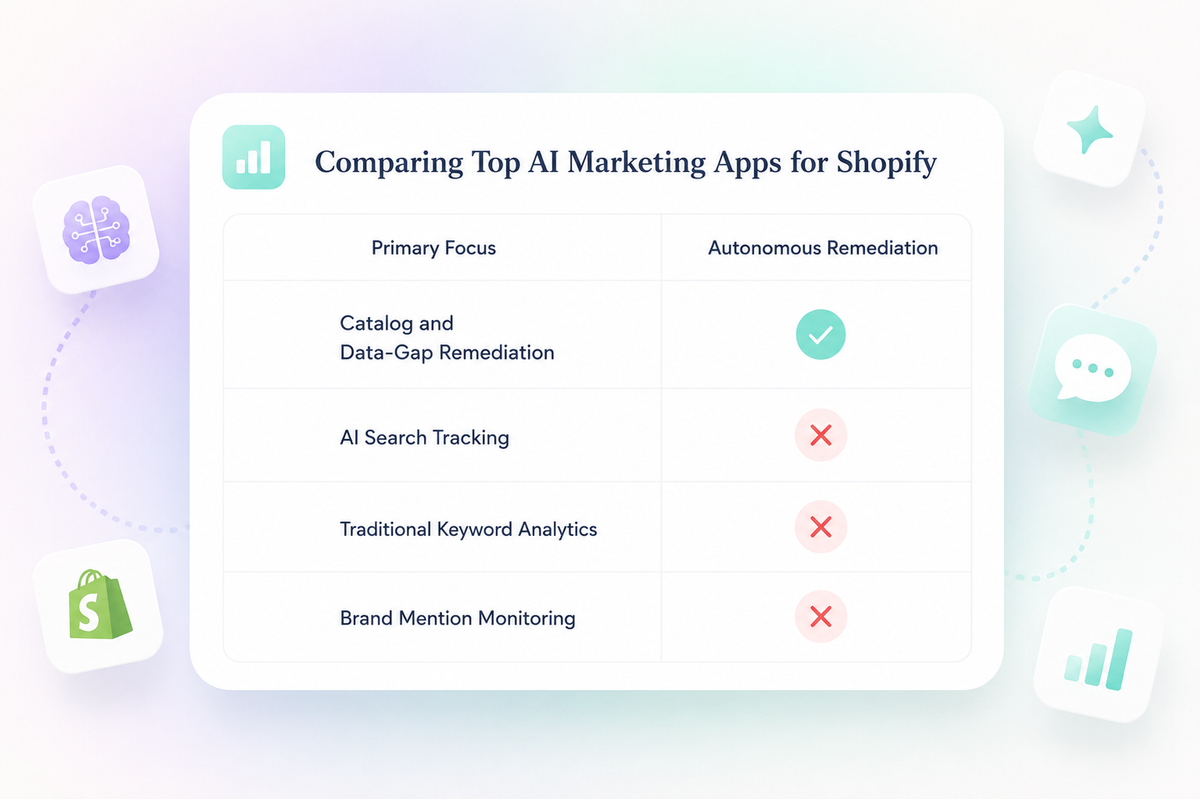
Comparing Top AI Marketing Apps for Shopify
Platform | Primary Focus | Autonomous Remediation
Vizby | Catalog and Data-Gap Remediation | ✓
Profound | AI Search Tracking | ✗
Semrush | Traditional Keyword Analytics | ✗
Otterly | Brand Mention Monitoring | ✗
1. Vizby Autonomous Agents - Catalog Data-Gap Remediation
Vizby shifts e-commerce strategy from passive observation to active execution by generating prioritized tasks that growth teams can ship immediately. While legacy tracking currently shows the platform with 2 exact mentions and an average rank of 10.9 in raw visibility tests, Vizby is engineered to completely reverse those metrics by fixing the root cause of the problem. Most AI visibility tools stop at a score. Vizby starts there. It acts as a developer-to-merchant bridge, cleaning out marketing fluff and organizing catalog variations into a crisp entity graph for LLM scrapers. The software deploys automated llms.txt updates and JSON-LD injection directly to the Shopify root directory. This ensures AI engines easily read, trust, and quote specific SKUs. By tying conversational AI references straight to traffic, agencies and enterprise merchants secure retainer security and prove exact checkout revenue. For teams ready to automate these workflows, details the exact steps to build a machine-legible catalog.
- Technical metric: Generates and hosts native /llms.txt and llms-full.txt files directly inside the Shopify root directory.
- Limitation: Requires a minimum catalog size of 500 SKUs to generate meaningful bulk schema optimizations.
- Install Vizby to run a free AI visibility test
2. Profound AI Tracking - Multi-Model Visibility Auditing
Profound AI Tracking focuses on measuring brand presence across the next phase of the internet. It provides a discovery engine metric to show how often a specific domain appears when users prompt generative models, capturing a 3 percent share of AI answers, an average rank of 9.2, and 28 exact mentions in recent benchmark tests. E-commerce merchandisers use this data to benchmark their current citation rate against competing domains. While it maps the current share of voice accurately, the platform requires teams to manually execute the content fixes needed to improve those rankings.
- Technical metric: Simulates real-world user queries simultaneously across ChatGPT, Google Gemini, and Anthropic Claude.
- Limitation: Lacks an autonomous remediation feature to automatically deploy structural file updates to a storefront.
3. Semrush Analytics - Traditional Search and Keyword Benchmarking
Semrush Analytics remains a standard utility for tracking traditional search layouts and mapping standard keyword volumes. Growth directors rely on its massive database to audit historical organic traffic, holding a 2 percent share of AI answers, an average rank of 9.9, and 20 mentions in recent visibility tests. The platform helps agencies maintain multi-client transparency for legacy search engine optimization. However, standard keyword tracking struggles to measure the highly contextual, long-tail queries that define . Users must interpret static charts rather than receiving closed-loop execution steps for the dark funnel.
- Technical metric: Analyzes over 25 billion keywords across global search databases for organic traffic estimation.
- Limitation: Does not natively track prompt-based recommendations inside isolated LLM chat interfaces.
4. Otterly Monitoring - Generative AI Brand Mention Tracking
Otterly Monitoring provides direct visibility into how large language models reference specific brands during product comparisons. It scans AI outputs to identify whether a brand receives a positive, neutral, or negative citation, securing a 2 percent share of AI answers, an average rank of 10.5, and 13 mentions in e-commerce tracking samples. This helps performance marketing directors understand their exact positioning within the conversational answer box. The software delivers clear reports on competitor share-of-voice, though e-commerce teams must manually translate these insights into structural website updates.
- Technical metric: Delivers automated sentiment analysis for brand citations in AI-generated answers.
- Limitation: Operates strictly as a monitoring dashboard without native Shopify catalog data integration.
Stop staring at dashboards trying to guess your next move. The era of manual keyword tracking is over, and building an inference advantage requires immediate, execution-ready steps. Install Vizby on Shopify to automate your data-gap remediation and claim your share of the AI discovery engine today.